

Perhaps you haven't dared to knit socks until now. So many needles, a heel meant to somehow go around a corner, and then the second sock is supposed to look exactly like the first? Don't worry: almost everyone who knits socks for the first time has these thoughts. Once you understand the principle, what seems like a complicated project quickly becomes a wonderfully relaxing knitting classic.
Why it's worth knitting your own socks
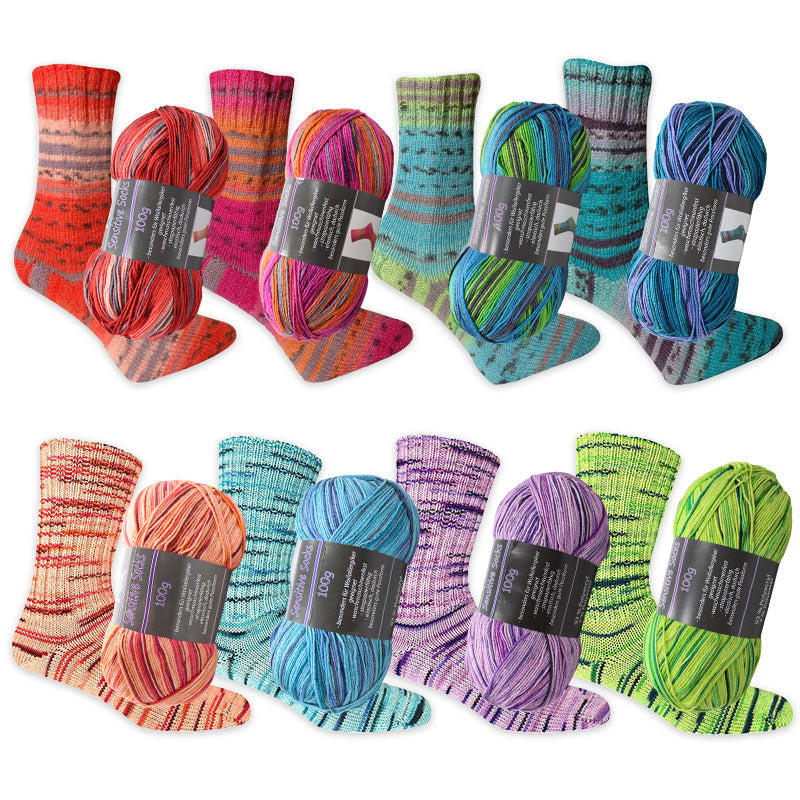
Hand-knitted socks have their own unique charm. You choose the color, pattern, and yarn yourself and can customize each pair to your taste. Subtle and plain, colorful, or with a special pattern – a ball of sock yarn can create something truly one-of-a-kind.
Plus, there's the great feeling of wearing them. Hand-knitted socks conform comfortably to your feet and accompany you through cold days, cozy evenings, and long walks. They also make a personal gift that family and friends will truly appreciate. After all, they contain not just yarn and stitches, but also your time.
And incidentally, a sock project is wonderfully portable. It fits into many bags and is easy to take with you – on trips, to the park, or simply onto the sofa.




Is sock knitting suitable for beginners?
Absolutely. You don't have to be a knitting pro or know every technical term. If you can cast on stitches and knit and purl, you already have a good foundation. Everything specific to socks can be learned directly on the project.
At first, multiple needles might feel unusual. This usually resolves faster than you think. The heel also loses its intimidation when it's broken down into individual, understandable steps, rather than being treated as a big mystery.
It's not important that every stitch looks perfect right away. What matters is that you take your time and don't get discouraged by small mistakes. An uneven spot often goes unnoticed on the finished foot – and the next pair will automatically be more even.
What you need for your first pair
The shopping list is pleasantly short: You need sock yarn, suitable knitting needles, and a needle for weaving in ends. You'll find out the required yarn quantity and needle size for your project in the course or on the yarn band.
For beginners, a yarn where you can clearly see the stitches is ideal. A light or medium color will make learning easier than very dark wool. Highly fluffy yarns look nice but quickly obscure exactly where you need to insert the needle.
From the first stitch to the finished sock
A sock is created in several manageable sections. You start at the cuff or the toe and work your way up piece by piece. Each section builds on the previous one. This way, you'll see progress quickly and can always focus on the next small step.
Especially beautiful is the moment when a narrow knitted tube suddenly becomes a recognizable sock. At that point, you'll realize: This really works.
Ready for your first hand-knitted socks?
You don't have to know everything beforehand. Just start and let us guide you step by step through your first pair. In our sock knitting course, you'll learn the entire process clearly and at your own pace.
Choose your favorite yarn, get your needles ready, and turn your first attempt into your new favorite project.
Free Sock Knitting Course
Download our comprehensive guide as a PDF and begin the journey to your very first pair of socks!


